Pest, IX, Boraros tér (T 4,6), 8 min
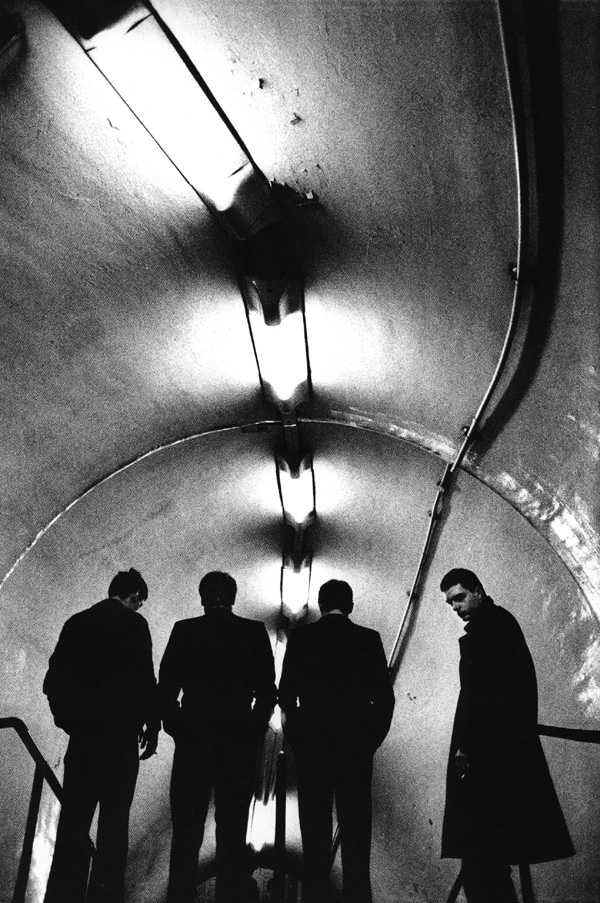
 Fast forward almost thirty years and that same photographer is making his first feature-length film, Control, a biopic about the tragic life of Ian Curtis, the troubled troubadour of that little band he photographed in a London Tube station.
With such clear "bookends," it's a fine time for a massive career-spanning retrospective, simply titled, “Work.”
Corbijn has photographed countless integral underground and mainstream musicians, made some of the most recognizable music videos of all time – Nirvana’s “Heart-Shaped Box” being one – and reduced some of the world’s biggest film stars to meager-looking mortals. (One exception is his portrait of physicist, Stephen Hawking, who he makes look like a rock star.) Dylan, Ginsberg, Cash, U2, Kraftwerk, Waits, De Niro, Eastwood...his list of subjects goes on in impressive fashion.
“Composition is easy,” Corbijn said, at a recent free screening of Control at A38, part of the "Holland Kultfeszt." He says he places the importance on the person behind the camera, an emphasis easy to make if you've got a portfolio like Corbijn's.
Regardless, you'd find it hard to argue the fact that his work is strung together in a manner that is distinctly his. The graininess that comes from a 35mm negative being blown up beyond the natural limit, and the blurred subjects, rendered imperfect and almost featureless, are both signatures of his early work in black and white .
 Later in his career his prints shrink down and sharpen, yet there is no connection lost between photographer and subject. It’s obvious that Corbijn somehow gets these celebrated people to open up. He forces them into a relationship with the camera; either that or he coaxes it out of them. Judging from Corbijn’s modest demeanor and the intimacy reflected in his photographs, the latter is probably true.
His numerous photos of Depeche Mode are a case in point. An entire room is devoted to them, in honor of the role he's played in their visual aesthetic that's always been akin to their music.
 In recent years, Corbin has turned the camera on himself, or rather versions of himself dressed as other people. In the series “a. somebody” he employs a style of self-portrait that evokes the work of Cindy Sherman. Here, Corbijn imitates musicians who died in full glare of the media, some he worked with (i.e. Ian Curtis, Kurt Cobain) and some he never had the chance to (i.e. John Lennon).
Walking through the multitude of photographs that make up Corbijn’s life's work, one can truly grasp the weight of these images. While they can be visually stunning, both for the saturation and the simple compositions, they also cut through the gloss to show a more intimate, human side of those that so often placed atop pedestals.
Yes, the chance to photograph four skinny, shivering musicians from Manchester served as the launch pad for Corbijn, but, like his subjects, it's taken more than luck to keep him amongst the stars. If you’re a fan of photography, music, or stardom, this exhibition shouldn’t go unseen.
Anton Corbjin Antwon Corbin Antone Corbwin
Műcsarnok, until 17th May
Dózsa György út 37 (Hősök tere) [map]
Pest, XIV, Hősök tere (M1), 2 min
From large video works and performance art, to photographs, installations, and paintings; strangely, it all links up under the umbrella of “human discourse,” unlike another group show happening in Budapest at the moment. From familial turmoil and oddities (see Jesper Just and Tracey Moffatt), to sexual and surreal (see Marina Abramovic and Pipilotti Rist), to war and human destruction (see Cristina Garciá Rodero and Thomas Hirschhorn); the ugly and the beautiful are shown side by side in immaculate curatorial fashion.
 If the attendance at the opening is any indication of the importance of Mi Vida, then the fact that you could barely move speaks volumes, and some recognizable names don't hurt either. One might expect with 36 artists and over 100 pieces, there’d be plenty of duds. However, nothing could be further from the truth. Sure, artists like Canadian heavy-hitter, Marcel Dzama, are that bit more accomplished but the lesser works are more than just filler.
Dzama’s small-scale ink and watercolor drawings are surrealist and comic book-esque. They are without background or contextual objects allowing the fantastic characters’ peculiar actions to fill the empty space. The paintings of re-worked Polaroids in Enrique Marty’s “La Familia” are equally imaginative. The color and technique is devilish, violent and unsettling, evoking something reminiscent of The Texas Chainsaw Massacre.

While Dzama and Marty’s works play primarily in the realm of the bizarre, the large-scale photo capturing destruction on a road in Kabul by Luc Delahaye, brings the exhibition back into the realm of reality: the pain of personal loss that lies behind the camera’s main focus. Meanwhile, Tomas Hirschhorn’s massive installation entitled United Nations Miniatures, may appear comical on the surface, before the stark reality behind the miniaturization of so many indistinguishable war atrocities sets in.
 It’s not all doom and gloom though. An entire room (blatantly marked 18+, so kiddies beware!) is dedicated to Serbian artist, Marina Abramovic’s “Balkan Erotic Epic.” Here Abramovic questions the presentation of “information” by documenting obscure, sexual agricultural rites. Despite their patent absurdity, they remain somehow convincing. The video of the women in traditional garb running around in the rain flashing their genitals and breasts to the sky, and the one of the naked men frantically thrusting into the soil are guaranteed to amuse, at the very least.
 Also following a comedic line, is Candice Breitz’s “Mother” – the distillation of six famous motherly roles in Hollywood films. Each mother, including actresses Meryl Streep and Julia Roberts, is given her own screen in a pitch-black room where they are arranged in a stadium-like semi-circle. Everything around them is digitally removed, blackened out, focusing the attention on their emotions. The repetition of noises, snivels, and moans showcases the spectrum of motherly emotions in a span of just 13 minutes.
 The presentation of much of the work is inventive and follows with the “on the cutting cusp” execution and feeling of the show. This is most evident in the presentation of Wolfgang Tillmans’ photographs, which are strewn about the wall in an erratic but calculated fashion. Some are massive, high-hanging and framed, others are small and simply taped, un-matted, to the wall in a series.
Only the work of American photographer, Ryan McGinley is largely underwhelming. McGinley has become highly regarded as a young photographer in the past ten years, and Műcsarnok’s promotional posters boast that his work is included in the show. However, to me, his photos are highly self-indulgent and lack any real discourse: it’s just American youth in the desert, nakedly basking in their parents’ trust fund.

Mi Vida is a show that is exciting for its presentation and near-flawless execution, and also for the subjects that are tackled within. The most poignant trends in the contemporary art world lie within the walls of Műcsarnok at this very moment. Get there at any cost before the show closes on the 17th of May!
All photos courtesy Műcsarnok, except the topmost.
Jacob P.

Pest, IX, Boraros tér (T 4,6), 8 min

The art that comprises New Acquisitions is mostly what they’ve purchased in the past couple of years and is all contemporary, if not the newest in new. Pieces by Hungarian artists make up most of the show, but there are several works from artists around the world including Chinese artist, Csi Peng, whose “True And False Money King” might hint at a fitting theme.
Alas, the selection of photography, painting, sculpture, collage, and video seems to have everything but unity. An exhibition of recent acquisitions is bound to be a mixed bag but here the emphasis is most definitely on the 'mixed'. The neon piece, “Little Warsaw” doesn’t really tie in with Péter Gémes’s brilliant, pictogram-esque large-scale black and white negatives, nor Antal Lakner’s comical “Passive Working Devices” (above, right). But then again, nothing meshes.


Something that always tends to wear me out at these group shows is the sheer amount of video work on display. I feel like an A.D.D. kid inside a Chuck E. Cheese that’s inside of a Toys R Us that’s inside of a McDonald’s PlayPlace. Then, when you get to watch them, it suddenly transforms into a series of 5-15 minutes comas... and New Acquisitions has 7 of them.
Jacob P.
Műcsarnok, until 15th February 2009
1200Ft.
Dózsa György út 37 (Hősök tere) [map]
Pest, XIV, Hősök tere (M1), 2 min
One of his greatest concerns is commentary on the image as well as photography as a medium, to illustrate first-hand that a photograph is not in fact what Roland Barthes would call the “spectrum” - the actual things being photographed. Rather, Ruff’s work concentrates on Barthes’ “stadium” - the interpretation and contextualization - or in Ruff’s case, re-contextualization and de-contextualization. He is not so much a Photographer as he is an Artist, or Mediator.
His most noted work to date is his jpeg series where he pulls somewhat iconic images from the Internet - such as the freshly attacked, yet still standing, Twin Towers in New York - blows them up to enormous proportions (the long side usually measuring around 3 meters), and pixelates them, removing information which renders them unrecognizable at close range. However, the image of the 9/11 attack (ny02, 2004) is missing from the show, bringing into doubt how representative this “retrospective” actually is.
His other noteworthy series that features photos pulled and manipulated from the Web are his Nudes, a series of pornographic photos. The artist doesn’t pixelate these images in the same manner but instead blurs them, bringing countless genitals, plastic-looking breasts and vinyl lingerie into the realm of what might just border on tastefulness.

Ruff has been doing what he calls “sampling,” ever since his Stars series from the 1990s, where he takes detailed photos of the night sky that were made by astronomers who had the very powerful equipment he didn't have access to. Here, Ruff is displaying and appropriating them in the form of large C-prints. The same goes for his Newspaper Photographs, in the sense that he’s “stealing” the images. The artist liberates newspaper photos from their captions to see if they still mean anything to the viewer, and of course the iconic ones (i.e., Hitler) do, and the banal do not.
 Some of the work in the exhibition will have you wondering what exactly Ruff considers photography in the first place. His Substratum series, for example, just looks like old iTunes visualizer screen shots. Similarly, in the Zycles series, which takes centre stage in the exhibition space, Ruff uses computer formulas to create huge psychedelic canvases, which he likens to children’s meaningless scribbles. And meaningless they are, especially with the sub-par explanations he gives with each series. Perhaps he reveals too much; that there really isn't as much going on behind each photo as one might give him credit for.
 One of the finer points of the show is the fact that Ruff focuses on precision within fine art, especially with his large-scale passport style portraits (which, gasp, he actually took). He is a product of the Academy of Art that studied under the Bechers, who, along with his peers, such as Thomas Struth and Andreas Gursky, elevated photography into the realm of fine art. These technically crafted, extremely large prints are a fine example.
Such technical precision, however, may easily be lost on anyone outside the world of photography, and is unlikely to be enough to make the aesthetics of this exhibition alone stick with you for very long.
Jacob P.
Plenty of Penises to Go Around - Keith Haring at the Ludwig
0 comments Posted by hub culture at 20:57 LUMU, until 16th November,
1200 ft (discounts available)
Komor Marcell u. 1 [map]
Pest, IX, Boraros tér (T 4,6), 8 min
Hot on the heels of what would have been Keith Haring’s 50th birthday (4 May), Budapest’s Ludwig Museum of Contemporary Art has brought a prominent American artist’s work to Hungary.
The fact that most of the pieces in the Haring exhibition span only a few years is a bit of a disappointment but you can hardly hold that against the Ludwig — AIDS tragically and bitterly cut his life short seventeen years ago, at the ripe age of 31. Having said that, while there are only so many fruitful years from an artist who dies young, the exhibition did seem to lack certain items that would have helped show the diversity in Haring’s graffiti-inspired expressions.
Although it isn’t billed as a retrospective, there is perhaps a simple solution: some of his famed chalk drawings from the NYC subways would have made it come close (if indeed, any were even saved or preserved). Instead the museum attempts to sum up Haring’s life with a pretty lacklustre timeline as you walk up the stairs. Check Keith striking a vogue with Madonna in that Polaroid! Wow-wee!
Haring’s work balances many aspects of living in America in the 1980s (New York City to be exact) — consumerism, the backlash against the advertising industry, the AIDS crisis, and race. Haring managed to pull this off without being preachy. Cheeky, yes, but fantastically so. The result is something extremely thought-provoking, certainly what the artist was shooting for in a time with so much cultural garbage.
One thing anyone will notice after stepping through the door is the prevalence of penises in probably 80% (my rough estimate) of his work. Any guy who can use that sheer amount of phallic representation, and continually come up with something new must have had something going on upstairs.
 Personally, I’m a fan of art that doesn’t take you days to extract a deep meaning from and Haring’s use of well-known cultural symbols to drum up discourse is intelligent without being over-bearing. As far as I‘m concerned, Warhol never seemed to say that much, but Haring takes Warhol‘s ideas a step beyond.
Take for example, one of the larger pieces from the show, Prophets of Rage, 1988. It’s homage to his buddy Jean-Michel Basquiat just before his fatal drug overdose. There’s a ton of cultural symbols: the oppressed black man, crumbling religion, a suffering and decapitated Jesus, power, money…. Point is, you can use signifiers to come up with something new that will remain relevant.
One of my biggest qualms with the exhibition in general is the fact that the main piece used in advertising it, 1982’s Untitled (the ‘red dog figure tossin’ around those two green dudes‘, as I like to call it) is grossly misrepresented in all of the promotional material for the show. If you’ve got a set of working eyes and have been in Budapest for any length of time, even an airport layover, then you’ll probably have seen some sort of publicity for the exhibition - specifically this piece.
 Well, if you do go, check it out, not that you have any choice. This thing is NEON! NOT the primary red and yellow plastered onto posters all around Budapest. I’m talking spandex bicycle shorts, Day-Glo snap bracelets, “surfs up dude”, full on 80s neon. Maybe they didn’t want to spoil the vivid, eye-aching sensation of actually seeing the piece up close… although, I guess I just did.
All told, Haring’s work is definitely worth a trip to the Ludwig, whether you're a fan, on the fence... or even if you just have absolutely no idea who this guy is.
Jacob P.
Masterpieces of the Swiss Rupf Collection - Picasso, Klee, Kandinsky
0 comments Posted by hub culture at 21:08
Until 27th January, 2008
Museum of Fine Arts, Hősök tere [map]
Pest, XIV, Hősök tere (M1), 1 min
If you haven't noticed that The Museum of Fine Arts is playing host to a Picasso, Klee and Kandinsky exhibition, you probably don't use the metro too much. Being listed first, the Picasso brand-name clearly has the most pulling power, although that's Klee's "Legend of the Nile" on the poster. What kind of split will the exhibition have, I wonder?
2200HUF seems quite pricey to me but 10% off with a little card from the tourist office is briefly enough to take the sting out of it. I then ponder the wisdom of buying a ticket at all when I find that there's no one on the door.
Inside the gallery, it's quickly clear that this particular sample of Hermann Rupf's collection isn't going to be a case of a couple of paintings and a few sketches. The exhibition is more-or-less chronological, split into two around 1930. This exposes what a tight-knit bunch the early cubists were: string instrument, newspaper, wine bottle, grapes... were Picasso, Braque and Gris all trapped in the same room? Perhaps things will change in the next gallery...hang on, what's this? "Guitar, Bottle and Fruit Dish" (1921).
Some quirky sculptures by Laurens liven it up a bit and Derain's landscapes are an oasis in a sea of still lifes. Picasso does finally come through with the squawking, light-hearted "Young Girl" (1929), which amuses me greatly.
The second half, for me, was far more exciting, thanks in no small part to Klee, who's a lot more varied than I gave him credit for. I'm not sure whether my memory beat my eyes to the notion that Klee has a certain penchant for swastikas - but it seemed that as soon as I thought it, I noticed them. This led to a little (more) confusion as to how to interpret the paintings. In fact, he'd been using them well in advance of Hitler, so it appears that continuing the trend throughout the thirties was an act of defiance, from the seemingly safe distance of Paris.
Kandinsky is also well-represented, with a series of colourful balancing acts and miniature universes from the 20s through to the 40s. It's the Kandinsky I know and love and seeing them in the flesh, makes me realise how few colours there are in the digital world. I'm also happy to see that Kandinsky did occasionally depart from this style, with the juxtaposition of Quiet Tension (1935), a personal highlight. In contrast, Picassos seem a bit thin on the ground, the bulk of his stuff being in the first half. Only now do I feel that some cobbling together is going on: neighbouring paintings have an identical theme and there's a distinct missing room where the freaky portraits should be.
So, if Picasso is supposed to be the main act, he's somewhat upstaged by Klee and Kandinsky. Nevertheless, if you're not too partisan or bothered about seeing the famous ones, there's a lot of quality on show.
The Museum of Fine Arts is the huge neo-classical building on the left side of Hősök tere, as you approach from Andrássy út.
Andy Sz.


